

CBN: The Sedative Architect – A Deep Dive into Nighttime Resilience and Neuroprotection

I. The Sedative Architect: Introduction to CBN
As we navigate the high-stakes landscape of 2026, the demand for restorative rest has never been higher. In 'The Garden' of SC Botanicals, Cannabinol (CBN) stands as the master architect of the night. While CBD provides the foundation of daily homeostasis, CBN is the specialized tool we employ when the goal is profound, uninterrupted recovery.
Often referred to as the 'sleepy cannabinoid,' CBN is much more than a sedative. It is a molecule of resilience—protecting the brain's most delicate structures while inviting the body into a state of deep, somnambulant relaxation. For the modern professional, CBN is the bridge between a high-output day and a transformative night.

II. The History: The First Discovery
CBN holds a unique place in history: it was the first cannabinoid ever identified and isolated. Scientific literature first mentioned Cannabinol in 1899, decades before THC or CBD were understood. For the first half of the 20th century, researchers actually believed CBN was the primary active constituent of the cannabis plant.
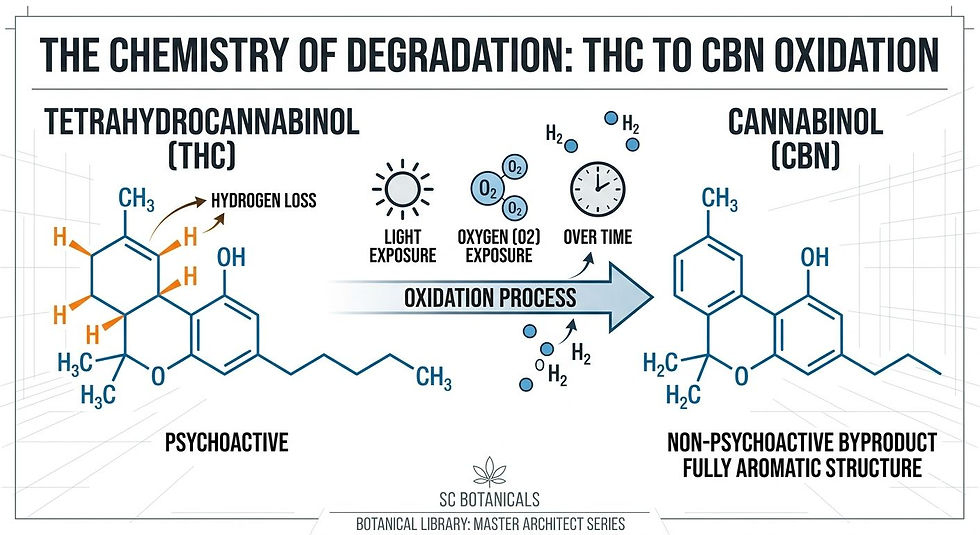
It wasn't until the 1964 discovery of THC's structure by Raphael Mechoulam that the true nature of CBN was revealed. CBN is not a primary product of the plant's metabolism; rather, it is a byproduct of time. As THC is exposed to light and oxygen over time, it oxidizes and transforms into CBN. In the ancient world, aged cannabis was prized for its 'heavy' and 'grounding' effects—an early, intuitive recognition of the CBN-rich profile we now cultivate with laboratory precision.
III. The Chemistry of Oxidation: THC to CBN
At the molecular level, CBN is a testament to the transformative power of oxidation. When Tetrahydrocannabinol (THC) degrades, it loses hydrogen atoms and becomes Cannabinol. This process significantly alters how the molecule interacts with the human body.
In 2026, SC Botanicals utilizes 'controlled oxidation' techniques. Instead of waiting for years for natural degradation, we work with Loon Labs to gently accelerate this process in a clean, laboratory environment. This ensures a high-purity CBN extract that retains the beneficial terpene directors while stripping away the psychoactive 'edge' of its THC progenitor.
IV. Pharmacology: The ECS & Nighttime Affinity
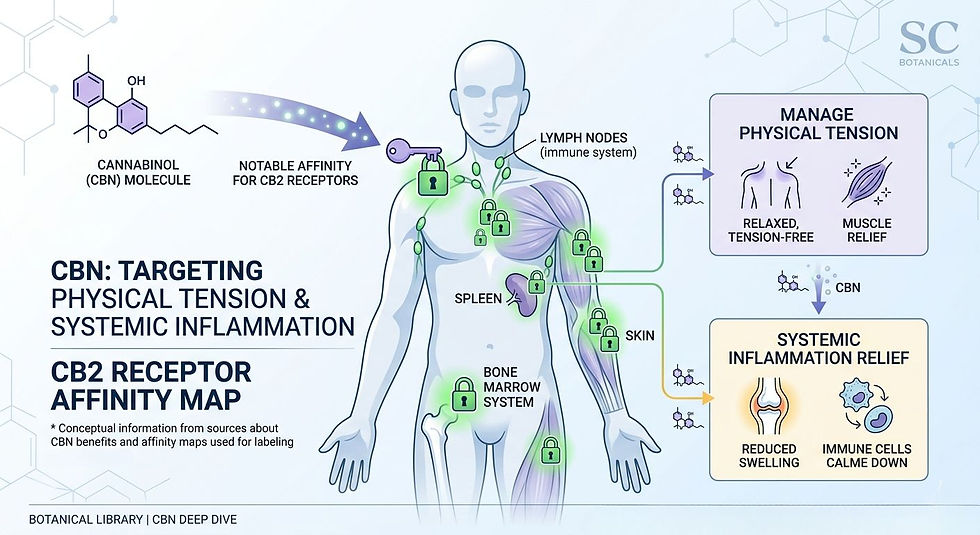
CBN's pharmacology is distinct from both CBD and THC. It is a weak partial agonist at the CB1 and CB2 receptors, meaning it has a physical affinity for the Endocannabinoid System without the 'overload' that leads to intoxication.
1. The CB2 Connection
CBN has a notably higher affinity for CB2 receptors, which are primarily located in the immune system and peripheral tissues. This makes CBN an exceptional candidate for managing the 'physical' manifestations of a long day—muscle tension, systemic inflammation, and the general body-fatigue that can prevent relaxation.
2. The Sedative Threshold
Unlike THC, which can sometimes cause racing thoughts at high doses, CBN acts as a 'down-regulator.' It encourages the release of neurotransmitters that signal the body to downshift. In clinical observations from early 2026, CBN has been shown to enhance 'sleep architecture'—specifically increasing the duration spent in deep, restorative sleep stages.

V. Clinical Research 2026: The Sleep Breakthrough
The most exciting research of 2025 and 2026 has focused on CBN's comparison to traditional pharmaceuticals. A double-blind trial in 2024 (TruCBN study) found that dosages of 50mg to 100mg of CBN significantly improved sleep quality, rivaling the efficacy of 4mg of melatonin but with a superior subjective sense of stress relief.
More importantly, 2026 sleep lab results show that CBN's primary strength is not just 'falling asleep,' but 'staying asleep.' It addresses the issue of sleep fragmentation—the 'midnight wake-ups' that plague those with high cortisol levels. By stabilizing the sleep cycle, CBN ensures that the user wakes up feeling actually restored, rather than 'foggy' or sedated.
VI. Neuroprotection: The Mitochondria Connection
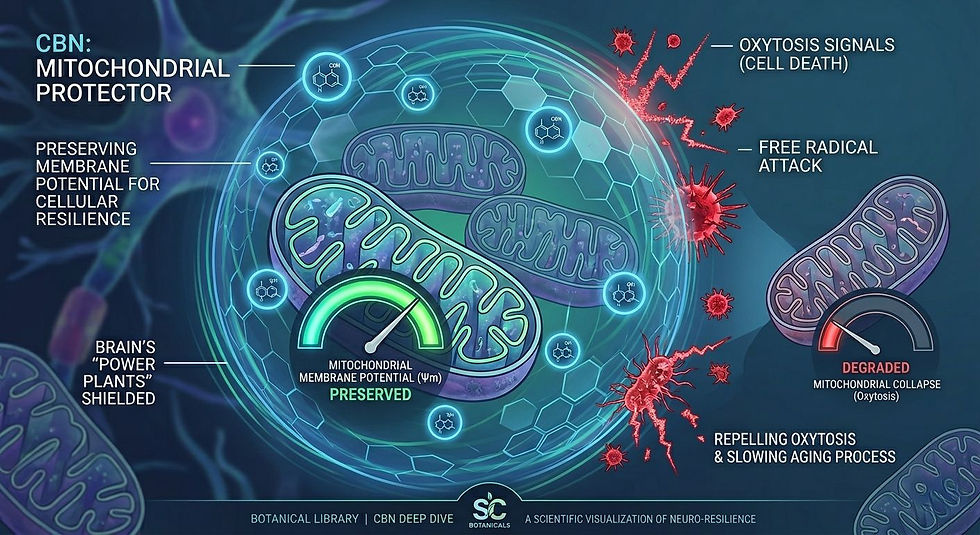
Beyond sleep, CBN is emerging as a powerful neuroprotective agent. Research from California's Salk Institute in 2026 reveals that CBN protects the brain from oxytosis (a form of cell death) by targeting the mitochondria.
Mitochondria are the 'power plants' of your brain cells. As we age, these power plants can become damaged or inefficient. CBN helps preserve the mitochondrial membrane potential, effectively slowing down the brain's aging process at a cellular level. This makes CBN a vital 'pillar' for those focused on cognitive longevity and neuro-resilience.
VII. Extraction Standards: Glass, Steel, and Loon Labs
Because CBN is a product of oxidation, it is often treated as a 'secondary' cannabinoid by industrial producers, leading to lazy extraction methods. At SC Botanicals, we reject this standard.
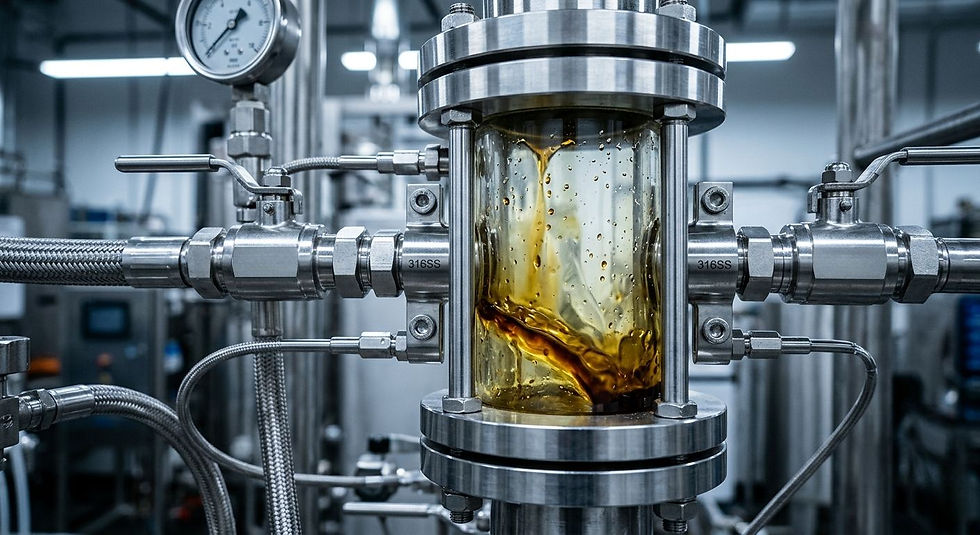
We utilize Loon Labs' precision hydrocarbon extraction, housed entirely in 316-grade stainless steel and medical-grade borosilicate glass. This prevents any chemical leaching and ensures that the delicate nighttime terpenes—like Myrcene and Nerolidol—are preserved. When you experience CBN from SC Botanicals, you are tasting the clean, artisan reality of a molecule that has been handled with absolute reverence.
VIII. Synergy in the Garden: CBN + CBD
In our Botanical Library, CBN is rarely used in isolation. It works best in synergy with the other residents of 'The Garden.'
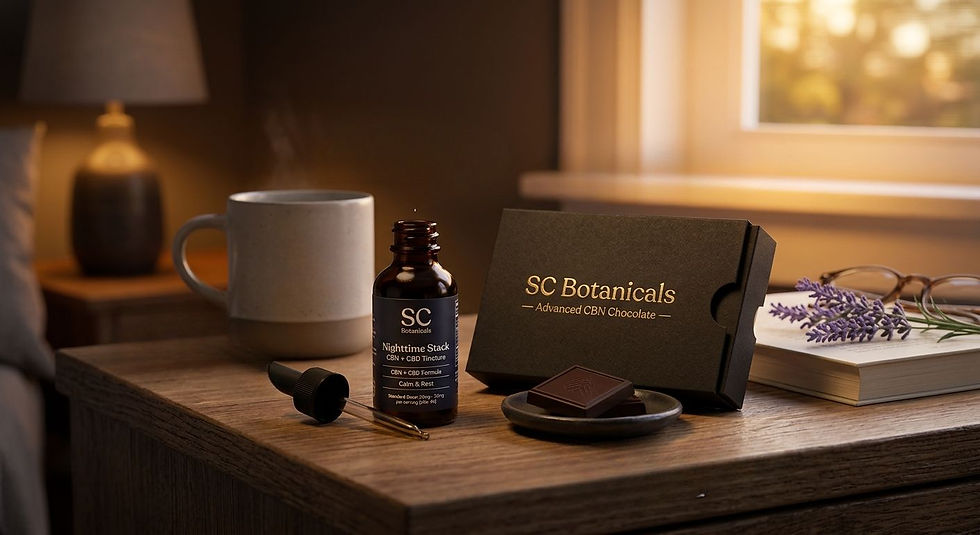
The Nighttime Stack (CBN + CBD)
This is the foundation of a 'Modern Industrial' evening. While CBD works on the general anxiety loops and daily homeostasis, CBN tilts the body specifically toward sleep. When taken together, they address both the mental and physical barriers to rest.
IX. Dosing & Safety: The Artisan Guide
In 2026, the standard for a functional 'nighttime' dose has settled between 20mg and 50mg for most users. However, for those dealing with significant sleep disruption, high-potency servings of 100mg (as seen in our advanced chocolate line) provide a profound physiological reset.
As with all SC Botanicals products, our CBN is strictly 21+, hemp-derived, and 2026 OCM compliant. Every batch is verified through a rigorous COA process, ensuring that 'clean' is a measurable fact.
X. Botanical Library FAQ: CBN
Q: Will CBN make me feel groggy in the morning?
A: No. Unlike pharmaceutical sleep aids, CBN supports the natural sleep architecture. Most users report waking up feeling refreshed and clear-headed.
Q: Is CBN psychoactive?
A: CBN is technically a very weak psychoactive compound, but at functional doses, it does not produce a 'high.' It is primarily experienced as a heavy, grounding physical sensation.
Q: How long does CBN take to work?
A: When taken as an edible or in our artisan chocolate, CBN typically takes 45–90 minutes to reach peak effectiveness. We recommend incorporating it into your 'wind-down' ritual about an hour before sleep.
Q: Why does CBN cost more than CBD?
A: CBN is rare. It only exists in trace amounts in the plant and requires specialized, high-end extraction and conversion processes to isolate in its pure, artisan form.
Conclusion: The Foundation of Rest
CBN is the final piece of the daily wellness puzzle. By mastering the night, you empower the day. Through the lens of SC Botanicals, CBN is not just a supplement—it is the architecture of a resilient life.


Comments